
 Instagram
  Facebook
  TikTok
 Wind Farm Construction on Polonyna Runa: A Controversial and Highly Relevant Issue
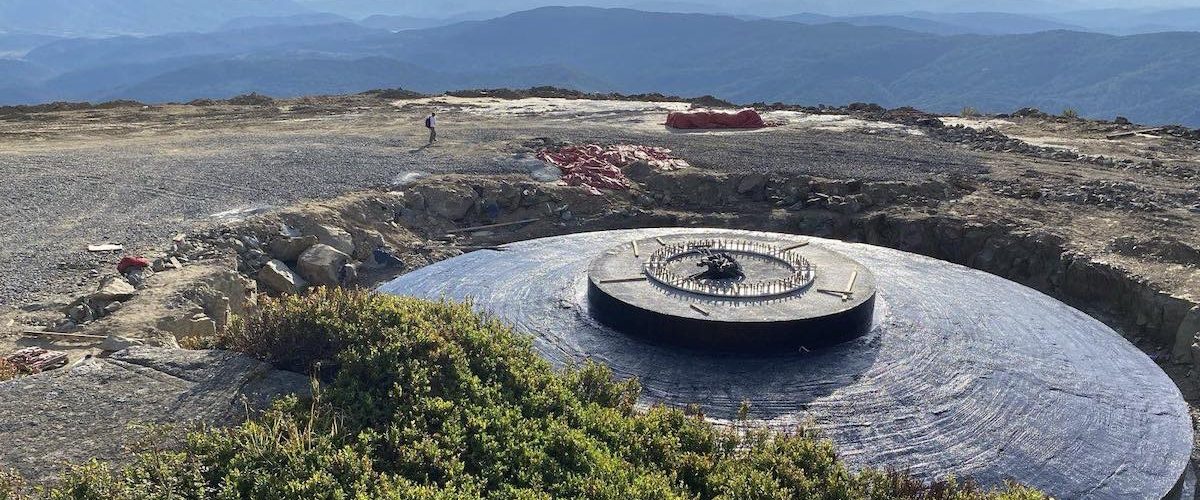
The construction of a wind power plant on Polonyna Runa in the Zakarpattia region has unexpectedly evolved from a local infrastructure project into a nationwide debate on energy and environmental policy.
The project by Wind Parks of Ukraine предусматривает installation of 30 wind turbines with a total capacity of up to 156 MW within the Turye-Remety community. It has revived an old but sensitive question: what price should Ukraine pay for the development of green energy?
The trigger for the large-scale public debate was the announcement by Minister of Economy, Environment and Agriculture Oleksii Sobolev that the project received a positive Environmental Impact Assessment (EIA).
The decision was made despite more than 500 appeals from environmental organizations and citizens, most of whom opposed the construction.
The ministry states that the site is not part of a protected nature reserve, is not classified as primeval forest, and is not an internationally protected wetland. The project also does not require deforestation, as access to the installation sites will use an existing road.
Officials also note that the area has been influenced by human activity since the 1960s due to a former military facility, and that detailed environmental studies were conducted in 2023–2024, including research on bird migration and bat activity.
A key argument is political: the project aligns with a decision of the Verkhovna Rada that identified mountain areas of the Carpathians as zones of public interest for strategic energy facilities.
Why the Protests Continue
For environmental groups and part of the local community, these arguments are not sufficient.
Activists point to risks of fragmentation of mountain ecosystems, the possibility of setting a precedent for further industrialization of alpine meadows, and what they describe as an insufficient level of public dialogue.
Critical opinions have been voiced publicly, including by PAEW head Liudmyla Tsyhanok, who stresses the need for extreme caution in high-mountain regions.
Environmental expert Petro Testov warns that if Polonyna Runa becomes a standard case, similar projects could spread to other Carpathian ranges.
In his view, formal compliance with EIA procedures does not always guarantee that long-term environmental consequences are fully considered.
Business and Government Present Arguments in Favor
Representatives of the business community emphasize energy security and strategic necessity.
Former Naftogaz CEO Andriy Kobolyev compared the situation to the resistance that once accompanied the development of domestic gas production. At the time, concerns also seemed insurmountable, yet without difficult decisions the country would not have reduced its energy dependence.
Support for the project among many industry representatives is based on a simple logic: wind power is one of the few sectors capable of quickly increasing generation without fuel imports and with minimal CO₂ emissions.
A Debate Larger Than One Project
The discussion has gone far beyond a single location.
It has revealed a systemic weakness — a lack of trust between the state, business, and society.
Even when procedures are formally legal, tensions remain if decisions are perceived as being made without meaningful dialogue or clear explanation of trade-offs.
Polonyna Runa has become a symbol of the choice Ukraine faces during wartime and energy transformation: the balance between speed of development and public consensus.
Whether wind turbines in the Carpathians become a symbol of sustainable progress — or another point of conflict — will depend on the state’s ability to ensure transparency, open communication, and real public participation in decision-making.